The Mosaic Problem - Solved!
| GitHub Repo 👾 | YouTube Video 📺 | Scope: ⭐⭐⭐⭐ | 🚧 Under Construction 🚧 |
This is a followup to this post.
Reintroducing the Mosaic Problem
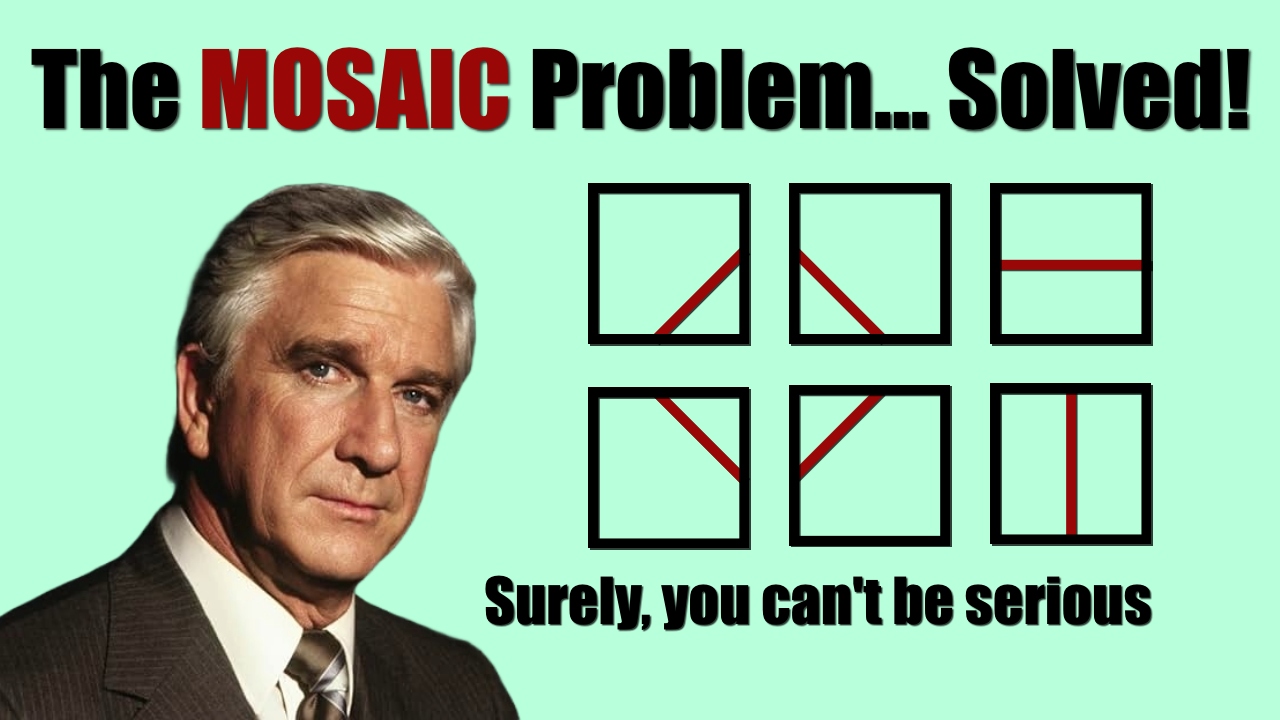
Take the following six tiles

and create a $n \times m$ rectangular grid using them. Let’s call these grids mosaics. For example, below is a $(7,5)-$mosaic.

Clearly there are $6^{nm}$ possible mosaics. The question is for a given $n$ and $m$, how many mosaics contain at least one connected “loop”, like below?

I would later learn that these loops are called self-avoiding polygons, but I just refer to them as polygons in the paper and this post.
A Complete Solution
About a year after I published the video, I received a comment claiming to have a method for computing $t_{n,m}$ for small fixed $m$. The comment came from a user called Farstar31, who suggested a new method that we were able to generalize into a final solution.
After some discussions over twitter and email, we worked out a method to compute $6^{nm} - |S^{(m,n)}|$ for any $n$ and $m$! Later work refined and improved the solution to the following result.
Definition. For integers $k \geq 1$ let $A_k, B_k, C_k, D_k$ be $2^{k-1} \times 2^{k-1}$ matrices with integer entries, where $A_{1}=\begin{pmatrix}6\end{pmatrix}, B_{1}=\begin{pmatrix}-1\end{pmatrix}, C_{1}=\begin{pmatrix}1\end{pmatrix}, D_{1}=\begin{pmatrix}1\end{pmatrix}$, and
\[\begin{aligned} A_{k+1} = \begin{pmatrix} 6A_{k} & B_{k} \\ C_{k} & D_{k} \end{pmatrix} & B_{k+1} = \begin{pmatrix} -A_{k} & B_{k} \\ 0C_{k} & D_{k} \end{pmatrix} \\ C_{k+1} = \begin{pmatrix} A_{k} & 0B_{k} \\ C_{k} & D_{k} \end{pmatrix} & D_{k+1} = \begin{pmatrix} A_{k} & -B_{k} \\ C_{k} & 6D_{k} \end{pmatrix}. \end{aligned}\]Theorem. The number of $(m,n)$ mosaics that do not contain a polygon $|S^{(m,n)}|$ is the $(0,0)$ entry of $A_{n}^m$.
Proof. The proof is lengthy, so the full writeup can be found here.
If you are in desperate need of larger values for this question, here is a table up to $n,m \leq 6$:
| $6^{mn}-|S^{(m,n)}|$ | 2 | 3 | 4 | 5 | 6 |
|---|---|---|---|---|---|
| 2 | 1 | 73 | 3,960 | 190,475 | 8,580,671 |
| 3 | 31,998 | 10,414,981 | 3,005,175,624 | 812,051,193,421 | |
| 4 | 20,334,816,290 | 35,193,424,502,954 | 57,038,790,790,258,922 | ||
| 5 | 365,320,963,733,070,822 | 3,551,140,805,014,640,314,548 | |||
| 6 | 207,033,904,357,764,188,604,003,507 |
For our above example, we have $|S^{(5,7)}| = 33,119,798,046,247,294,513,136,340$.
Further Questions
What is the smallest such $n$ such that $1 - 6^{-n^2}|S^{(n,n)}| \geq \frac{1}{2}$? Empirical evidence suggests $n \approx 30$, but both enumeration methods detailed in the proof don’t scale to this size.
What is the value of $\alpha = 6^{-1} \lim_{n \to \infty} |S^{(n,n)}|^{\frac{1}{n^2}}$?
Thank you for reading!